Posts

A Whole Lot Of Nope

In light of recent outrages, there are a lot of people posting bloodthirsty things on social media. If you post bloodthirsty things, I want you to know I don't stand with you on that. I may agree with your underlying cause(s) and reason(s). But I don't want people to be killed. I don't want looters to be killed. I don't want protesters to be killed. I don't want suspects to be killed. I don't want curfew-violators to be killed. I don't want civilians to be killed by cops. I don't want cops to be killed by civilians. I don't want politicians killed. I don't want community leaders to be killed. I don't want bystanders to be killed. I'm not claiming that all of these things are equivalent. The only equivalence is that I want all these people to go home at night, and justice to be accomplished without bloodshed. I'm not suggesting outrage is unfounded. I'm not saying nothing should be done. I will suggest that if escalat...

Speech Hacks to be More Decisive

I was in a leadership program with Christoper Avery some years ago. In that program, people would say “ don’t should on yourself. ” Another friend had years ago told me that “should” is the saddest word in English because it means you see value in something, haven’t done it, and probably won’t. I embarked on a quest to get rid of some aspects of self-defeating speech: Instead of “I’m sorry” say “Thank you” Instead of “No thanks, I can’t eat that” say “No thanks, I won’t eat that.” Instead of “I don’t know how” say “I haven’t learned YET ” Instead of “ I should ” say “I may ” or  “I would like to “. You know, these little things make a difference for me. The speech patterns are more decisive and confident, reflect agency and choice, and generally help me avoid shame (in myself) and appearing uncertain or indecisive. These are just little things, and it's not magic. One a person chooses an attitude they need to find language that supports that attitude. My speech...

Some Covid-19 Information

Hello all. From time to time, I will post something that is not on-brand for Agile Otter Blog at all, but is of concern at a point in time or in celebration or mourning. Today I'm listing some resources related to the Coronavirus COVID-19. A quick warning: there is a thin line between being informed about the virus and being obsessed with it. You should have the facts, and these sites will help you. But don't be so obsessed that you can't think about anything else. Take precautions, follow guidelines, don't be fooled by myths, don't search for miracle home cures. Take care of yourself and your family, and try to continue living a productive and normal life. I took time out to gather a few resources for you, but I have other things to do too. May we all get on with delivering value to each other and serving our communities of practice as well as protecting our friends and family. Don't panic. Do take precautions as recommended. Info and advice: WHO...

The Laptop "Problem"

Image
A few friends of mine have been pretty down on people using computing devices during meetings. The very presence of open laptops, tablets, phones, etc, gives them the impression that people are disinterested and disrespectful. You might know the individuals in question, there are a few of them and they all have some pleasant association with me in the past, they are friends, and I'm not here to talk about them. I want to talk about Curiosity Over Judgment instead. Corporate Training A long time ago, when I was working for a company in the great midwest, we took a class on crucial conversations. Our instructor was from headquarters and so was clearly an Important Person. The topic was clearly a Very Important Corporate Topic to have flown someone in from headquarters and cancel a day of work to educate us. My friend had an apple device that was his exclusive note-taking machine. If one is to take notes, it's best that they're collected together, and having them on...

Disciplined Breaks, Two Years On

Image
I described Disciplined Breaks here in 2017. Sometimes people ask me how that's working. I wish my answer was more confident and assertive, but what I can say is "it works great when we do it." I use Disciplined Breaks in all of my training and coaching engagements, and often in conference talks. It works. 100% of the time it works. It works so well that people feel like they're cheating. They feel guilty for not being tired. When I'm not there to enforce it, the teams practice it sporadically at best. When they work solo, few of them ever continue it (even though it works 100% of the time).  Worse, when I work solo, I also sometimes "forget" to do it. Yes, even though it works all the time. We are talking about human beings and their sense of sufficiency and power and their work ethic and competitive, go-getter training. Disciplined Breaks is a behavioral skill, and all behavioral skills (especially formal disciplines) are hard. We are be...

The Coward's Confrontation: Leadership fail

I want to introduce you all to a term: Cowards' Confrontation: a rule made in order to avoid having an uncomfortable conversation with an individual, which rule is either selectively relevant or selectively reinforced (or both). So, for instance, a 15-person team exists of which only two people ever eat at their desks. One has a cold sandwich and carrot sticks, but the other brings tuna and shrimp freshly heated from the cafeteria's microwave oven.  The team has been bothered by the fragrance of the daily seafood and the residue left in the trash can. The team (or a manager at the team's request) makes a rule that there will be no eating in the workspace. Our sandwich-eater ignores the policy with impunity. After all, this person knows that the policy was about smelly seafood and doesn't apply to them. Nobody, team member or manager, says anything. The seafood-eater notices the sandwich-eater's scofflaw behavior and returns to their desk with food one da...

Is It My Fault You Can't Handle The Truth?

Image
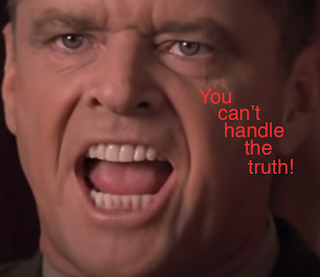
You can't handle it! In 2018 or 2019, I was introduced to the idea of hyper-rationality. I think it was under another name (to be given shortly) and as part of a presentation by George Dinwiddie on, of all things, estimation. It was a funny place to be introduced to ideas from psychology and family therapy, as well as organizational psychology and collaboration, but there it is. It is nice to be smart. It's extra nice to be right. It is wonderfully nice to be right, smart, rational, and helpful to others. Sometimes we put too much emphasis on being right and forget to be helpful. Hyper-rationality is a state of being excessively or inordinately rational. It is a belief in rational truth as an unassailable fortress, that being correct is all that matters. For instance, consider the sentiment that if I am right or I am telling the truth  then you have no right to be offended or upset. It might feel right, but it sounds wrong. When people are acting hyper-ra...