Posts

The Curiosity Space

Image
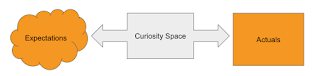
Sometimes we get what we expect. The reactions to that? Either satisfaction or no real reaction at all. When I put my bread in the toaster and it toasts it according to the settings, I don't throw a party. After all, that's what the toaster is for.  The water tap dispenses water, just like always, and that's what I expected. I'm glad for toast and water, but it's not something that will occupy a lot of my thoughts. If I put in bread and got back a waffle, that would be surprising. I would spend more of my day on that.   Likewise, if I put in bread and received a flood of fleeing insects, that would be surprising. Which brings us to the point: sometimes what we get is different from what we expect. We can feel that as delight sometimes, because our results were far better than we expected. Other times we feel it as disappointment. If we judge this space, we will feel it as frustration, failure, embarrassment. even disrespect and loss of control. We c...

The Relevance Ratio

As another bit of speculative, observational humor let me introduce you to the Relevance Ratio. What it is: Consider where you are sitting right now, and the last task you tried to do there. Now, consider/remember the information around you on all sides. The posters, conversations, sounds, words, materials. Pretend you measured this information content and assigned it a number like maybe 100 (just to make the math simple). Next, look at all that information content and determine how much of it is not relevant to the work you are doing. Do you have posters? Clutter? Radio? A television playing? Reminders of other work to do? Clocks (not pomodoro)? Dilbert posters? Are there things you have to reach around or past in order to do your work? Consider it all. Do you have a coffee cup? That's information too -- because it urges you to make a beverage decision. Candy dish or lunch box? Food decisions.Say it's a 60.  About 60% of the information in your view has nothing to d...

The Intimidation Cycle

I look at how hard people try to combat fear with fear -- X is afraid of Y, so  X tries to make Y afraid of them in return, and  X escalates to make sure Y is the more afraid, so  Y cranks up the intimidation even more, because Y can't let X win. Y says "X needs to fear US!", so  (repeat paragraph)... I wonder, how long will we keep doing this? And I'm told: as long as the other guys are winning. Breaking the cycle is possible, but you can bet that when it ends, it won't be because one side won.

Curiosity over Judgment: getting past defensiveness.

Image
Say someone wants some aspect of my behavior to change: dress, schedule, food, drink, speech, whatever. I initially get a little upset, defensive. But that's not productive. That's just anger and ego protection. Is there a more excellent way? I'm told that the secret to success is to replace judgment ('that's none of your business", "you are trying to control me", "screw off, I do what I want", "that's not fair") with curiosity . "replace judgment with curiosity " Curiosity. Hmmm. Let's try that. I wonder where that will lead. I'll have to suspend my anger and judgment and blame and quit assigning motives to others if I'm going to process this with curiosity. So much is possible now, and there are so many questions: So, why is it so important to you that I change how I behave? Is it for a purpose?  Does it serve you in some way?  Is it because you care about me and think it ...

What is "Agile"?

Most of agile is about delivering sooner and a lot more often , so that you can incorporate the client's desires and feedback into your daily work.  The rest is about how to make that sustainable for development teams.

Naming is still hard.

Ideally, we would have excellent and obvious names for all variables, classes, packages, methods, etc. But it's hard to be excellent all the time. People building the java libraries struggled with names, I can tell, and though I don't always appreciate their choices I recognize that this is a multifaceted problem. Maybe a moment of agonizing over a bad name might help share a mental model, and some patterns or smells for naming methods. Let's give it a shot. A Tiny Example Here is a tiny, dull, dumb snippet:  Date now = new Date();  DateFormat df = DateFormat.getDateInstance(LONG, Locale.FRENCH);  System.out.println(df.format(now)); Java has a method called getDateInstance() . Does it return an instance of a date? No, it does not. If it lived in a package called Date then it would be a terribly wrong name, but it doesn't live there. It returns an instance of a date formatter, whose class is called DateFormat. DateFormat doesn't seem like such a...

Sarah and Joe Write Features

I wrote a question for the twitterverse: I assigned a story each to Sarah and Joe. Joe's feature made the company 4x as much as Sarah's, so Joe is the better programmer, right? — Tim Ottinger (@tottinge) February 10, 2016 Give that question a moment's thought and tell me what you think as a knee-jerk reaction. About Joe and Sarah Of course Joe and Sarah are fictional characters. No this isn't a gender question. I thought it would be wrong of me to pick two female names or two male names. I figured that there is really no way that I am going to get out of this without answering to questions (or charges) of gender bias no matter what I do, and so I decided to pick two names roughly at random. It didn't dawn on me that they're both European/American kinds of names until later -- so bias is probably real there. But what if one was an Indian name and the other Chinese? I can see that having all kinds of issues too. So I have two names, and please ...